- Out of United States
- Posts
- The Id Unbound
The Id Unbound
America's Mr. Hyde

Maximum Demo
April 11, 2026
In the fevered cultural psychodrama of American politics, few characterizations have proven as enduring or psychologically resonant as Matt Taibbi’s early portrait of Donald Trump as “all id.” Writing in Rolling Stone around the 2016 campaign (and echoed in his 2017 piece “The Madness of Donald Trump”), Taibbi depicted the candidate as a creature of pure, unmediated impulse: “impulsive, all id, doesn’t give a fuck, riling up the worst impulses of the American electorate.” Trump, in this view, operated without the customary filters of ego or superego—the rational mediator and moral censor that Freud posited as the civilizing forces within the psyche. He was raw desire, rage, appetite, and self-aggrandizement, unbound. This was no ordinary politician; it was a figure who seemed to channel something primal and collective, a force that polite society had long repressed.
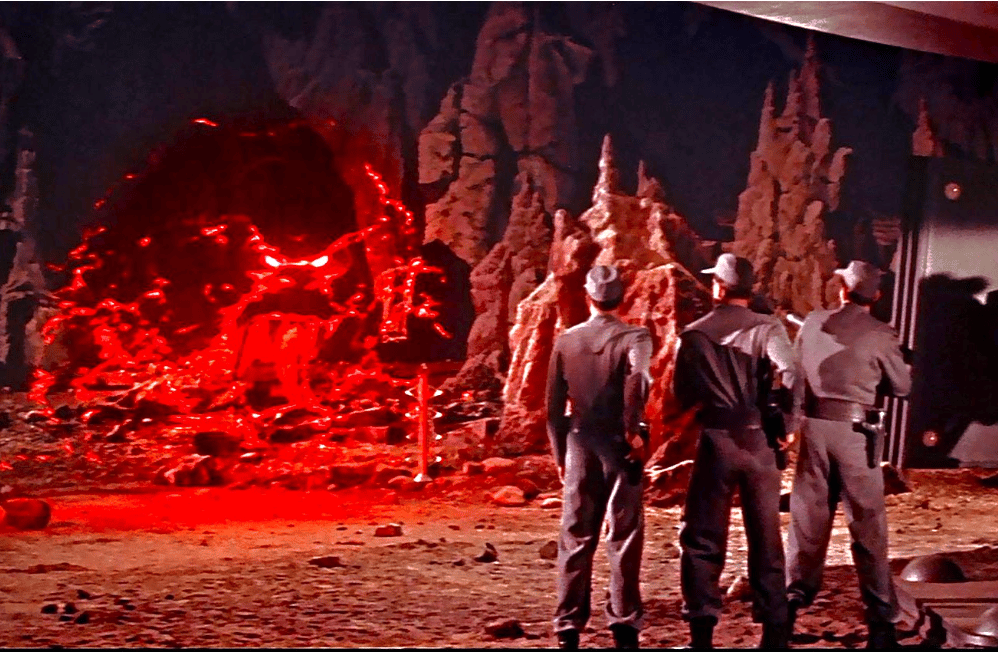
To extend Taibbi’s metaphor into the realm of archetype and myth is to see Trump not merely as a man but as a symbolic embodiment: the id-monster of Forbidden Planet (1956), the collective Mr. Hyde to America’s Dr. Jekyll, the projected shadow of the Jungian collective unconscious, and perhaps even a latter-day echo of the Beast of Revelation. Much like...wait for it...Mussolini and Hitler were for Italy and Germany during a time of social fragmentation and collapse, Trump has become the lightning rod for America's frustration and repressed energies.
In Freud’s tripartite model of the psyche—id, ego, and superego, the id is the oldest, most primitive layer: a seething cauldron of instinctual drives, operating on the pleasure principle alone. It knows no morality, no reality-testing, no tomorrow. It demands immediate gratification—sex, power, aggression, possession. The ego, by contrast, is the reality principle, negotiating between id and external world. The superego is the internalized parent, the voice of conscience and societal norms.
Taibbi’s framing precisely captured Trump’s campaign style. His rallies were carnivals of unfiltered id: boasts about crowd sizes, name-calling and mockery of opponents (“zingers” to his fans), promises of walls and bans that tapped raw tribal fears and desires. There was no careful policy scripting, no deference to decorum. Tweets arrived at all hours like id eruptions—raw, contradictory, emotionally volcanic. Critics on both sides noted the absence of shame or strategic restraint; even supporters marveled at the “authenticity” of a man who said what others only thought. This was not calculated performance in the conventional sense. It was, as Taibbi observed, a man who “doesn’t give a fuck,” operating as if the id had seized the wheel entirely.
In Forbidden Planet, on the distant world of Altair IV, Dr. Morbius activates the ancient Krell machine, a device that amplifies thought into physical reality. Unbeknownst to him, his unconscious resentment toward the visiting starship crew—fueled by possessiveness over his daughter and buried intellectual arrogance—manifests as an invisible, rampaging beast. The monster is not external; it is Morbius’s own id, given monstrous form by technology far beyond his conscious control. The parallel is striking: Trump did not “create” the cultural monster he became; rather, he served as a conduit for energies already latent in the American collective. The “machine” here was not Krell super-science but the modern media ecosystem—24-hour cable, social platforms, algorithmic amplification—that turned every impulse into spectacle. Trump’s very presence seemed to externalize what polite America had denied: the hunger for dominance, the thrill of transgression, the resentment of the dispossessed. He was the id-monster made flesh, stomping through the drawing rooms of the Republic.
In Robert Louis Stevenson’s Strange Case of Dr Jekyll and Mr Hyde (1886; btw, you must see the 1941 movie with Spencer Tracy, Lana Turner and Ingrid Bergman), Jekyll is the respectable Victorian gentleman—rational, moral, socially integrated. Hyde is his shadow self: brutish, violent, liberated from restraint, driven by appetite. In his quest to "cure" man of his base impulses, Jekyll concocts a potion that splits his personality into Good (ego/superego) and Evil (id), with the id gradually becoming more dominant.
America has long cultivated a Dr. Jekyll self-image: the city upon a hill, beacon of Enlightenment reason, constitutional democracy, melting-pot meritocracy, polite pluralism. This is the America of the Declaration, the New Deal, civil rights marches, and post-war global leadership—the superego nation, bound by norms, institutions, and aspirational virtue. Yet beneath it pulses a Mr. Hyde underbelly: chattel slavery, the frontier violence of manifest destiny, the raw capitalism of robber barons, the racial and class resentments that erupted in riots, strikes, and culture wars. Jekyll and Hyde have been battling, as it were, for centuries.
Trump embodies Hyde. His "greed is good" boasts about wealth, his unapologetic masculinity, his disdain for “losers” and “elites,” his celebration of strength over sensitivity made liberal America recoil in horror, seeing not a politician but a moral abomination. So-called Conservative America, or at least a significant portion, cheered the liberation.
For Jung, the shadow is the archetype of everything the conscious personality rejects: repressed instincts, moral failings, “inferior” traits. Individuation—the path to wholeness—requires confronting and integrating the shadow rather than projecting it onto others. When denied, the shadow returns as fate, often in exaggerated, destructive form. On the collective level, nations and cultures possess a group shadow: the sum of what a society represses in order to maintain its ego-ideal. Post-war America’s ego-ideal was liberal democratic progress—rational, inclusive, future-oriented, technocratic. Its shadow, therefore, included the opposite: irrationality, exclusion, nostalgia for hierarchy, raw tribal power, anti-intellectual vitality.
Enter Trump, the perfect shadow vessel: brash, crude, racist, misogynist, xenophobic. To his detractors, he is the shadow—racist, sexist, authoritarian, boorish. To his MAGA supporters, he is their redeemer. To evangelical Christians, he is the "imperfect vessel, anointed by God for a noble mission, like Persia's King Cyrus who freed the Jews" in the Old Testament--evangelicals actually spread this meme. Trump's victory in 2016 intensified a psycho-cultural polarization that was already there. The rage directed at him is, in part, the rage of a culture forced to gaze upon its own repressed face. Jung warned that the unrecognized shadow leads to possession; we're long overdue for a recognition, acknowledgement and reckoning.
In Revelation 13, the Beast rises from the sea, a chimeric horror with seven heads and ten horns, blaspheming the divine order. It is given authority by the dragon (Satan), worshipped by those whose names are not in the Book of Life. It deceives, demands allegiance, and presages the end times. The Beast is not mere evil but chaos incarnate—the primal, anti-logos force that disrupts the established cosmic hierarchy.
Trump's rhetoric—fiery, divisive, unapologetically carnal—evokes the Beast’s blasphemies. His base, in this telling, bears the mark of allegiance, blind to his flaws. The Beast represents the eruption of the collective shadow into history—the id-monster writ large, the Hyde unbound, the repressed made sovereign. America’s Jekyll civilization, built on rational contracts and moral restraint, confronts its own chaotic underbelly. Trump reveals the fragility of the old order. The sea from which he rises is the collective unconscious, squeezed by latter-day robber barons as globalization, technological disruption, and cultural dislocation make the present bleak and the future appear dark.
BBC’s The Century of the Self documentary (2002) traces the path of Edward Bernays, Sigmund Freud’s nephew, who became the guru of Madison Avenue, replaced the word “propaganda” with “public relations,” and helped corporations weaponize the id’s primal desires through sophisticated advertising and PR, deliberately undermining the rational ego and moral superego. Rather than building ego strength and self-mastery as the 1946 National Mental Health Act envisioned, this flood of engineered consumption kept Americans trapped in infantile impulses, replacing genuine maturity with endless pursuit of pleasure and status. The result was a society of “happiness machines” marked by greater unhappiness, emotional shallowness, and spiritual emptiness.
In Jungian terms, the promoted persona of radical self-expression and lifestyle consumerism created a false identity that blocked integration of the shadow—the repressed collective instincts, aggression, and darkness. Without this integration, true individuation became impossible, stunting America’s collective psychological and spiritual maturity into a fragmented, easily manipulated culture addicted to illusionary control. Jung insisted that the only path forward is confrontation and integration. The id-monster must be recognized as ours. Hyde is not an intruder but a neglected twin. The shadow is not evil but incomplete potential. The old order dying, but a new integration might be born.
Trump, in spirit and metaphor, forces America to look in the mirror. The howling rallies, the norm-shattering tweets, the raw grievances—these were the Krell machine of modern media amplifying the national id. To slay the monster is impossible without slaying a part of the self. The true task is psycho-cultural: to reclaim the repressed energies—vitality, assertiveness, unvarnished truth-telling—without letting them run amok; to honor the Jekyll without denying the Hyde. To integrate the shadow so that projection ceases and wholeness becomes possible.
The id-monster Trump embodies will persist until America undertakes the hard work of self-knowledge. As Taibbi saw years ago, and as Forbidden Planet, Stevenson, Jung, and Revelation all warn, the beast is not outside. It is the price of our civilization, the echo of our denial, the mirror of our soul. In a “normal” society, the id is increasingly regulated by the rational ego and the moral superego—conscience and ideals—as people mature and achieve psychic balance and civilized behavior (in Freudian terms). In Jungian terms, true maturity, or individuation, requires integrating the repressed shadow (dark, unconscious aspects) with the social persona (outer mask), allowing the self to become whole and authentic. It’s high time that, collectively, we grow up.