- Out of United States
- Posts
- The Bigger Lie
The Bigger Lie
Reagan's "Neo Con"

Maximum Demo
April 10, 2026
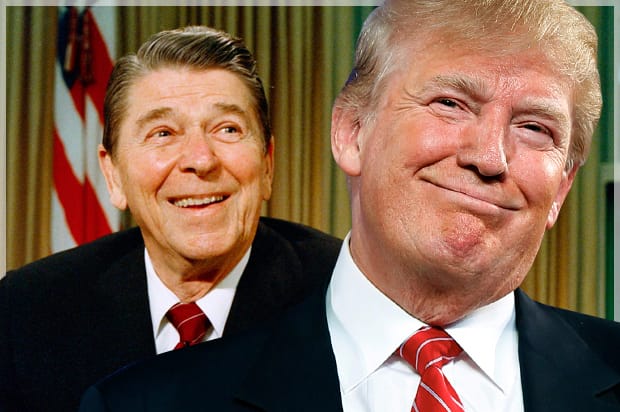
The so-called Big Lie—the persistent claim that Donald Trump actually won the 2020 U.S. presidential election—functions less as an isolated political myth than as a late-stage symptom of a far deeper, more enduring deception. The systematic inversion of American reality really began in earnest with Ronald Reagan's 1980 election and the infiltration of his administration by Leo Strauss-inspired neoconservatives. These figures, many of whom were staunch Zionists, fused messianic foreign policy with domestic theocratic and corporate illusions, all while the actual machinery of governance operated beneath a scripted presidency, backed by fossil-fuel fascists. The lie evolved through subsequent GOP administrations, twisting the national psyche into a hall of mirrors where fantasy supplanted fact. George W. Bush's 2002–2003 invasions of Afghanistan and Iraq were a fossil-fuel industry dream that bankrupted the US in more ways than one. The denouement came with what might be termed the "Bibi-Trump” invasion of Iran—the subservience of Trump to militant Zionism with the goal of a Greater Israel. The Bibi-Trump invasion also likely signals the end of American hegemony. Hopefully, it won’t escalate.
As Noam Chomsky said, the U.S. government "went underground" in 1981, while it was fronted by Reagan—an actor playing the president. Reagan delivered scripted lines and posed for photo-ops with giant props, his Hollywood-honed charm masking the real levers of power. This was no mere metaphor. Reagan's administration marked the triumph of image over substance, where the president functioned as a reassuring hologram while neoconservatives, drawn from Strauss's orbit, steered policy.
Reagan's path to power was paved by strategic alliances that embedded theocratic and militant elements into the Republican coalition. He was staunchly supported by the Southern Baptist Convention and the National Rifle Association (NRA), forging a dynamic that weaponized cultural grievance and gun culture as proxies for racial and religious retrenchment. The 1980 election saw Reagan endorse the rising evangelical right at events like the National Affairs Briefing, where he told conservative Christians, "I know you can't endorse me, but I endorse you." This pact with the Southern Baptist Convention and Pentecostal forces provided the moral veneer for policies that prioritized "family values" over social progress. Meanwhile, the NRA's influence entrenched a gun lobby that critics likened to a paramilitary extension of old Southern power structures. These alliances were not incidental; they represented the infiltration of religious fascism into governance, a counterforce to Enlightenment rationality.
The intellectual architecture came from Leo Strauss and his neoconservative disciples. Strauss, the University of Chicago philosopher, taught that liberal democracies required "noble lies"—mythic narratives of absolute moral values and external threats—to maintain social cohesion amid relativism. Disillusioned liberals like Irving Kristol and Paul Wolfowitz embraced this after the perceived failures of Lyndon Johnson's Great Society. They concluded that individualism had undermined national purpose; only a unifying enemy could restore it. As detailed in Adam Curtis's BBC documentary The Power of Nightmares (2004), these neoconservatives viewed Strauss's ideas as a blueprint: politicians must reassert myths to overcome moral relativism, creating a "mythical enemy" to bind the populace. Under Reagan, with allies like Dick Cheney and Donald Rumsfeld ascending, this faction gained influence. They exaggerated Soviet threats (via "Team B" intelligence) and laid groundwork for perpetual confrontation. Many neoconservatives were Zionists, prioritizing Israel's security in U.S. Middle East policy—framing American interests as inseparable from Israel's. From this vantage, neocons have since operated as proxies for Israeli strategic goals, from arming proxies to engineering regime-change wars that destabilized the region while advancing Tel Aviv's aims.
This reality distortion was clearly visible to some. Neurologist Oliver Sacks recounted an incident in his essay "The President's Speech" (later collected in The Man Who Mistook His Wife for a Hat). Patients with severe aphasia—unable to process words but hyper-sensitive to tone, gesture, and emotional authenticity—or those with right-hemisphere damage impairing prosody detection, watched Reagan on television. As the former actor delivered his practiced rhetoric, histrionics, and emotional appeals, the wards erupted in laughter. The patients detected the fundamental disconnect: words and delivery rang false, a grotesque incongruity between scripted sincerity and underlying artifice. The president's performance was transparently inauthentic to those unfooled by language! Sacks's anecdote illustrates how Reagan's detachment and videogenic skills created a collective self-deception, blinding the public to complexities.
Journalist William Greider captured this illusionism in his 1987 Rolling Stone piece "The Lonesome Drifter" (RS495, March 1987; expanded in a 1993 introduction). From Greider's vantage: "[Reagan] was a talented and cynical illusionist, using his videogenic skills to gull the country into destructive fantasies that evaded deeper social and economic problems. For others, he was an idealistic leader who exuded patriotic values and a sure sense of the nation's destiny. American idealism is probably the most important asset we have as a nation, a strength steadily eroded by disillusioning scandals in the White House...his detachment was part of his appeal. He seemed as fed up as the rest of the country with the complexities of government and the world. Most people bought into his reassuring, self-indulgent fantasy. The most dangerous thing about his nostalgic vision is that it blinds us to the present. Our willingness to condone the immoral or illegal activities by our government is rooted in the Cold War, the American obsession with worldwide ideological conflict. When the president's men routinely violate international law—it's an easy step for them to disregard domestic law as well. We've allowed our innocence to become a form of self-deception. Our idealism is twisted into a simple-minded world-view that is not only stupid, but dangerous." Greider's portrait underscores how Reagan's appeal lay in evasion: nostalgia as narcotic, enabling elite impunity.
Economically, neoconservative thought dovetailed with Milton Friedman's Chicago School monetarism. Friedman's antecedents—Frank Knight and Henry Simons—emphasized market discipline over Keynesian intervention. His followers, including Reagan's supply-siders, preached deregulation, tax cuts for the wealthy, and monetarist control of money supply as panaceas. This was no neutral science; it served the illusion of rugged individualism while hollowing manufacturing and inflating inequality. "Reaganomics" masked structural decay, aligning with neocon foreign adventurism by freeing capital for global projection—often in service of allies like Israel. Terms like "hubris" and "power intoxication" aptly describe the 1980s GOP ethos: a swaggering belief in American exceptionalism that ignored limits, much as later administrations would.
Theocratic infiltration began in earnest under Reagan, but its roots go far back. On New Years Eve in 1900, the Great Revival began in Topeka, Kansas, spawning the Pentecostal Assemblies of God (1914) as a counter to scientific rationalism and urban progressivism. Science at the time viewed Pentecostalism as "mass psychosis." Lawrence Wright's 1988 Rolling Stone profile "False Messiah" (RS530-31, July 1988) dissected Assemblies of God minister Jimmy Swaggart's scandals amid the Pentecostal surge, and how figures like Swaggart channeled Holy Roller fervor into political muscle, allying with Reagan's coalition. This religious fascism—framed as spiritual warfare—provided foot soldiers for culture wars, eroding separation of church and state.
Adam Curtis's BBC documentary The Century of the Self (2002) reveals the psychological underbelly of this zeitgeist. Drawing on Edward Bernays (Sigmund Freud's nephew), it traces how public relations engineered consent by stimulating irrational desires. Banks funded department stores in the 1920s; Bernays hyped consumerism as democracy's fulfillment. President Hoover hailed ad men for creating "constantly moving happiness machines." Freud's theories were weaponized: the Id's drives, once repressed, were commodified. Focus groups, motivational research (Ernest Dichter), and even CIA's MK-ULTRA experiments sought to "de-pattern" and reprogram minds. Anna Freud's conformist psychoanalysis clashed with critics like Herbert Marcuse and Wilhelm Reich, who saw society—not the individual—as the source of neurosis. The 1970s Human Potential Movement (Esalen, EST) birthed "self-actualization" via Abraham Maslow, which corporations co-opted. By Reagan's era, 80% of Americans fixated on inner-self expression, voting for his "new individualism": "Government is the problem." Lifestyle marketing sold identities; consumerism offered illusory control to the Business Elite. As Robert Reich noted, it triumphed self-indulgence. Freudian PR even aided coups, like Bernays's role in Guatemala 1953. The ratio of irrational to rational favored the irrational in America: a sadder, more unhappy nation than ads suggested. WWII German complicity showed how easily primal forces overwhelm democracy; psychoanalysts aimed to strengthen the Ego against the Id, yet never questioned their own societal premises.
This twisted psychology—hubris, intoxication, self-deception—pervaded GOP administrations. Bush's invasions, sold on weapons-of-mass-destruction myths echoing Strauss's noble lies, accelerated U.S. decline: trillions spent, alliances frayed, credibility shattered. Neocons' Israel-centric worldview persisted, with Trump amplifying it. His policies—moving the U.S. embassy to Jerusalem, Golan recognition, Abraham Accords—aligned seamlessly with Israeli expansionism. Big Lies sustain the base amid eroding empire, much as Reagan's nostalgia blinded the nation. Election denialism recycles the reality-twisting playbook—facts irrelevant, emotion and tribal myth paramount.
The Bigger Lie originated in Reagan's fusion of Straussian myth-making, theocratic fervor, Friedmanite economics, and Bernaysian psychology. It rendered the presidency performative, policy subterranean, and public discourse infantile. The Big Lie is merely its electoral echo: a desperate bid to reclaim the fantasy as material power slips away. America's deeper problems—irrationality amplified by advertising, primal forces unchecked—persist. Only confronting this lineage, not indulging it, offers escape from the hall of mirrors.