- Out of United States
- Posts
- Thanatos Rules
Thanatos Rules
Abrahamic Millenarians, Wagner & Hitler

Maximum Demo
March 27, 2026
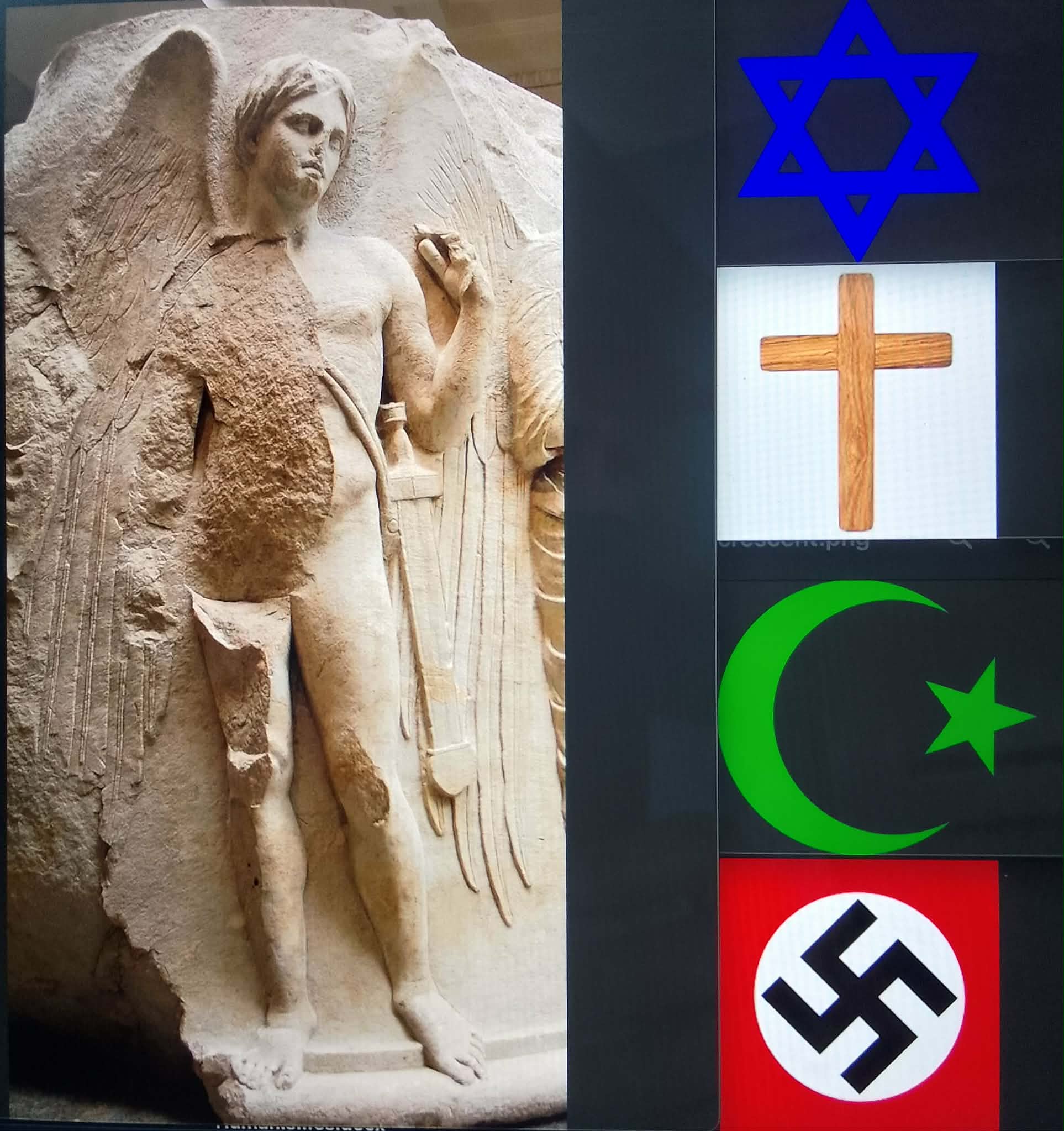
The three great Abrahamic religions—Judaism, Christianity, and Islam—share a profound eschatological structure that can be described as millenarian: the belief in a coming or returning messianic figure who inaugurates an era of divine justice, peace, and renewal after a period of cataclysmic upheaval. Central to this paradigm is a climactic global or near-global conflict centered on the land of Israel and the city of Jerusalem. In each tradition, the Messiah (or his equivalent) does not arrive in tranquil times but emerges amid what amounts to a world war—nations arrayed against the Holy Land, armies clashing in the Levant, cosmic signs of tribulation preceding ultimate victory. This is not mere coincidence of geography; the sacred landscape of Israel functions as the cosmic stage where history reaches its telos. Destruction is not an end but a necessary purification, clearing the way for a utopian new order.
This religious vision bears striking structural similarity to the operatic climax of Richard Wagner’s Der Ring des Nibelungen, particularly Götterdämmerung (“Twilight of the Gods”), in which the old world order of the gods collapses in fire and flood so that a redeemed humanity might arise. Wagner, the 19th-century German composer whose mythic dramas fused Teutonic legend with Romantic philosophy, portrayed devastation as aesthetically and philosophically indispensable to renewal. Adolf Hitler, an aspiring artist and fervent Wagnerian, absorbed this thanatos-driven aesthetic—thanatos being the Freudian death instinct, the drive toward destruction and dissolution—and wove it into Nazi ideology. For Hitler, total war, sacrificial ruin, and apocalyptic purification were prerequisites for the “Thousand-Year Reich,” a secular millenarian utopia. The thanatos theme thus threads through the Abrahamic eschatologies, Wagner’s stagecraft, and Hitler’s political vision: cataclysm is not tragedy but the forge in which paradise is hammered out.
In Jewish eschatology, the coming of the Mashiach (Messiah) is preceded by the “birth pangs of the Messiah,” a time of intense suffering that includes the War of Gog and Magog. The prophet Ezekiel (chapters 38–39) describes a vast coalition of nations—led by “Gog of the land of Magog,” often identified in rabbinic and modern interpretations with northern powers and allies including Persia (Iran)—invading a restored Israel “like a cloud covering the earth.” The attack targets a people “living securely” in the land, but God intervenes dramatically: earthquakes, torrential rain, hailstones, and fire consume the invaders. The bodies of the fallen require seven months to bury; their weapons fuel fires for seven years. Only after this cataclysm does the full Messianic Age unfold: ingathering of exiles, rebuilding of the Third Temple, universal knowledge of God, and an era of peace where “nation shall not lift up sword against nation” (Isaiah 2:4).
Rabbinic literature, including the Talmud and Midrash, elaborates that Gog and Magog represent the final existential war before redemption. The conflict is not regional skirmish but world-encompassing; nations rise against Israel, and divine judgment follows. Contemporary Jewish thinkers sometimes link current Middle Eastern tensions to these “birth pangs,” though mainstream Orthodoxy cautions against precise dating. The paradigm is clear: apocalyptic war in and around Israel—global in scope because it draws “many peoples”—is the indispensable prelude. The Messiah does not descend into utopia; he arrives to end the war and establish it. Destruction purges evil, enabling the utopian ingathering and eternal peace. This is millenarianism proper: a thousand-year-like (or indefinite) golden age on earth before ultimate resurrection and judgment.
Christianity inherits and transforms this Jewish framework. The Book of Revelation (chapter 16) explicitly names “Armageddon” (Har-Megiddo, the hill of Megiddo in northern Israel) as the gathering point for “the kings of the whole world” mobilized by demonic spirits for “the battle of that great day of God Almighty.” The Antichrist, having made a false covenant with Israel (Daniel 9:27), breaks it and unleashes persecution. Zechariah 12–14 depicts all nations besieging Jerusalem; half the city falls before divine intervention. Christ returns visibly (Revelation 19), feet standing on the Mount of Olives (Zechariah 14:4), to slay the assembled armies with the sword of his mouth. Blood flows to the height of horses’ bridles for 200 miles—the scale is global.
The Second Coming thus occurs amid what is essentially World War III focused on Israel: the final battle against the beast and false prophet, followed by Satan’s binding and the millennial reign (Revelation 20). Israel is both target and beneficiary; surviving Jews recognize their Messiah (Zechariah 12:10). The old order—corrupt empires, false religions—must be devastated before the new heaven and new earth emerge. Evangelical and dispensationalist traditions emphasize this literal reading, often viewing modern Israel’s conflicts as signs. Even amillennial or postmillennial Christians retain the symbolic core: cosmic war in the Holy Land precedes Christ’s triumphant return and utopian kingdom. The thanatos element is explicit—Armageddon is slaughter on a planetary scale—yet it births the millennium of peace.
Islamic eschatology mirrors these patterns with its own messianic figures: the Mahdi (a righteous leader from Muhammad’s lineage) and the return of Isa (Jesus), who descends from heaven to assist him. Major signs of the Hour include widespread fitna (tribulation), the appearance of the Dajjal (Antichrist—a one-eyed deceiver who claims divinity and conquers much of the world), and great battles in the Levant. Hadiths describe the Mahdi establishing justice after chaos; armies clash, particularly around Damascus and Jerusalem. Isa descends in Damascus (or near it), prays behind the Mahdi, then pursues and kills the Dajjal at the Gate of Ludd (modern Lod, near Tel Aviv in Israel).
Gog and Magog (Yajuj and Majuj) also appear, breaking their barrier to ravage the earth before being destroyed. Jerusalem and Palestine feature prominently: the Mahdi conquers or liberates the region; Isa breaks the cross (symbolically ending Christian distortions) and establishes Islamic justice worldwide. The end result is a brief golden age of peace and plenty under the Mahdi and Isa, followed by further signs and the Final Hour. Sunni and Shia traditions differ on details—the Mahdi’s identity, duration of rule—but converge on the necessity of apocalyptic war in the Holy Land. Modern popular sermons and literature sometimes frame Arab-Israeli conflicts or broader Middle Eastern wars as fulfilling these signs.
Thus, all three faiths share a millenarian paradigm: the Messiah (Mashiach, Christ, Mahdi/Isa) comes or returns precisely when the world is engulfed in war centered on Israel. The Levant becomes the eschatological battlefield—Gog/Magog, Armageddon, or the Mahdi-Dajjal confrontations. Tribulation is global in effect: nations mobilized, cosmic upheavals, moral collapse. Only after this purifying devastation does the utopian age dawn—Temple restored, millennial reign, or universal Islamic justice. The pattern is not accidental; it reflects a common Abrahamic theology in which history moves dialectically through suffering to redemption. Destruction is the necessary antithesis; without the war, there is no Messiah’s victory. Scholars note the “shared symbolic geography” of Jerusalem and the Middle East as the stage for final climax across traditions.
This religious template finds uncanny aesthetic parallel in Richard Wagner’s Ring cycle, which culminates in Götterdämmerung. Wagner drew from Norse Ragnarök—the prophesied doom of the gods involving cosmic battle, fire, flood, and renewal. In the opera, the old order of Valhalla, corrupted by power (the cursed ring), betrayal, and greed, collapses. Siegfried’s death, Brünnhilde’s immolation on Siegfried’s pyre, and the Rhine’s overflow trigger Valhalla’s fiery destruction. The gods perish; the world ends in conflagration and deluge. Yet the final orchestral bars, swelling in D-flat major, intimate rebirth: the Rhinemaidens reclaim the ring, and humanity (implicitly) inherits a cleansed earth governed by love rather than power.
Wagner’s stage directions and music portray devastation as cathartic and creative. The immolation scene is operatic thanatos writ large: Brünnhilde’s sacrifice redeems the ring’s curse, dissolving the corrupt cosmos so a new one—free of divine tyranny—can emerge. The cycle as whole dramatizes fall (Alberich’s renunciation of love for gold), fragmentation, and apocalyptic renewal. Wagner explicitly linked this to revolutionary hope: the old world must burn for the new to rise. His Gesamtkunstwerk (total artwork) fuses myth, music, and drama into a quasi-religious experience of destruction leading to utopia. Audiences witness not mere tragedy but dialectical progress—Hegelian in spirit, mythic in form—where thanatos (death, fire, flood) serves eros (redeeming love).
Adolf Hitler, an aesthete who failed as a painter but succeeded as a mythmaker, drew profound inspiration from this Wagnerian vision. He attended Götterdämmerung repeatedly, called Wagner his “only predecessor” and “supreme prophetic figure,” and declared that “whoever wants to understand National Socialist Germany must know Wagner.” Bayreuth became a Nazi shrine; the composer’s music soundtracked rallies, films, and even the Führerbunker’s final hours. Hitler saw in the Ring a blueprint for Germanic destiny: the old order (Weimar democracy, “Jewish” influence, international finance) must be destroyed in total war so the Aryan Reich could arise purified.
Nazi ideology itself was millenarian: the “Thousand-Year Reich” echoed Christian millennialism, promising utopia after apocalyptic struggle. Hitler’s speeches framed World War II as the final battle—Götterdämmerung on the world stage—against “Jewish-Bolshevik” forces. The Holocaust and scorched-earth policies embodied thanatos: sacrificial destruction of the “old” (racial enemies, decadent culture) to birth the “new man.” In the bunker, as Berlin burned, Hitler reportedly invoked Wagnerian imagery; the Reich’s collapse mirrored Valhalla’s flames, yet he imagined a mythic rebirth from the ashes. Historians note the regime’s “Ragnarok of the Reich” rhetoric—total ruin as redemptive.
The thanatos theme unites these phenomena. In the Abrahamic faiths, scriptural war in Israel is the death-drive mechanism purging evil for messianic utopia. In Wagner, operatic cataclysm—fire, flood, sacrificial death—is the aesthetic prerequisite for love’s triumph. In Hitler, political thanatos—world war, genocide, self-immolation of the state—served the fantasy of racial paradise. All three envision destruction not as nihilism but as dialectical necessity: the old must die violently for the new to live. Freud’s death instinct finds cultural expression here—Eros (redemption, love, justice) arises only after Thanatos clears the ground.
Religious eschatology is theological hope, Wagnerian drama is art, Nazism is criminal ideology. Wagner’s anti-Semitism fed later currents, but his works transcend any single appropriation. Abrahamic believers emphasize mercy alongside judgment; most reject violence to hasten the end. Yet the structural similarity remains: a cultural archetype across religion, opera, and 20th-century politics in which world-scale devastation—centered symbolically or literally on conflict zones like Israel—precedes utopian emergence. This paradigm exerts powerful psychological appeal: it renders suffering meaningful, promises justice after tribulation, and aestheticizes ruin as creative.
The Abrahamic millenarian vision, Wagner’s twilight, and Hitler’s delusion all illustrate humanity’s recurring fascination with thanatos as midwife to utopia. Whether divine prophecy, operatic myth, or political fantasy, civilizations that romanticize apocalyptic destruction risk summoning it. True renewal lies not in cataclysm but in rejecting the death drive altogether—choosing life amid the ordinary struggles of the Holy Land and beyond. Only then might the messianic age, or any golden era, arrive without the prerequisite of world war.
Jung regarded Abrahamic eschatology, Wagnerian Götterdämmerung, and Hitler’s millenarian politics as a single, colossal projection of the collective shadow. What Freud named Thanatos is, for Jung, not an autonomous death-drive but the unintegrated darkness of the psyche—archetypal aggression, greed, and the lust for purification—ejected outward and mythologized as “necessary” global cataclysm. Nations, races, or “evil empires” become the screen onto which the shadow is cast; Jerusalem or Valhalla merely supplies the sacred stage. Humanity’s urgent task, Jung counsels, is ruthless self-confrontation: to withdraw these projections, endure the fire of individuation, and assimilate the shadow within. Only then can the longed-for renewal arise from conscious wholeness rather than from the ruins of another self-fulfilling apocalypse.