- Out of United States
- Posts
- Forging Christendom, Subverting Christ
Forging Christendom, Subverting Christ
Imperial Standardization and the Politicization of Scripture

Maximum Demo
April 04, 2026
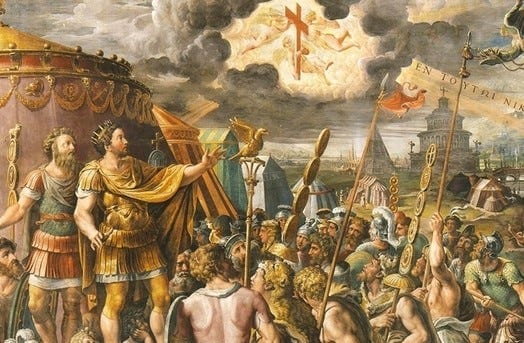
In the 350 years following Jesus’ crucifixion, Christianity emerged as an apocalyptic Jewish sect amid Palestine’s diverse religious landscape. Contemporary Jewish groups included Pharisees (law-focused), Sadducees (temple elite), and Essenes—an ascetic, communal sect known from the Dead Sea Scrolls for ritual purity, apocalyptic expectations, and separation from mainstream society. Though not a post-Jesus Christian group, Essene ideas of end-times prophecy, baptismal rites, and messianic hope likely influenced early followers, including possible links to John the Baptist.
By the late first century, Christianity spread to Gentiles via Paul’s missions, splintering into competing sects. Jewish-Christian Ebionites emphasized Torah observance and viewed Jesus as a prophet, not divine. Marcionites rejected the Old Testament God as a lesser creator, promoting a purely spiritual Christ. Gnostic groups (Valentinians, Sethians) stressed secret knowledge (gnosis) for salvation, often portraying the material world as flawed and Jesus as a revealer of hidden truths rather than a crucified savior. Montanists and others added prophetic ecstasy. These “Christianities” reflected fluid boundaries before any centralized orthodoxy.
Christian writings proliferated rapidly. Paul’s authentic letters (c. 50–60 CE) formed the earliest core. The four canonical Gospels emerged next: Mark (c. 65–70 CE), Matthew and Luke (c. 80–90 CE, using Mark and Q sayings), and John (c. 90–110 CE), along with the Gospel of Thomas (sayings collection, c. 50–140 CE, Gnostic flavor), Gospel of Peter (c. 70–160 CE); then the Infancy Gospel of James (c. 140–170 CE), Gospel of Mary, Gospel of Philip, Apocryphon of John, and Marcion’s edited Luke (mid-2nd century). Acts, epistles, apocalypses, and acts of apostles also circulated alongside the Didache and Shepherd of Hermas.
This textual and doctrinal diversity fueled conflicts. Proto-orthodox leaders like Irenaeus (c. 180 CE) in Against Heresies condemned “heretics” for altering tradition, rejecting apostolic succession, or promoting dualism. Gnostics and Marcionites challenged the creator God and public resurrection narrative; orthodox countered with creeds, bishops, and claims of eyewitness continuity. Debates over Jesus’ nature (fully human vs. divine illusion) and scripture’s scope intensified.
Yet the four Gospels gained majority acceptance among believers well before the Council of Nicaea (325 CE, focused on Arianism, not canon). Major apostolic churches in Rome, Antioch, and Ephesus favored them for historical rootedness and harmony. By 170 CE, Tatian’s Diatessaron harmonized exactly these four; the Muratorian Fragment listed them as authoritative. Irenaeus argued the four symbolized the universal church’s “pillars.” Proto-orthodox communities—numerically dominant and organizationally networked—used them in liturgy and teaching, marginalizing alternatives. By the early third century, the four-Gospel collection was standard for most Christians, setting the trajectory for later formal canons (e.g., Athanasius, 367 CE). This early consensus, born from grassroots use rather than imperial decree, shaped Christianity’s enduring identity amid sectarian strife.
In the early fourth century, the Roman Empire teetered on the brink of collapse. Decades of civil war, economic ruin, and barbarian incursions had fractured the tetrarchy established by Diocletian. Christianity, once a persecuted minority sect, had grown steadily despite the Great Persecution (303–311 CE), which saw churches razed, scriptures burned, and believers executed or forced into apostasy. By 312 CE, when Constantine emerged victorious at the Battle of the Milvian Bridge, Christians comprised perhaps 10 percent of the empire’s population but wielded disproportionate influence in urban centers. What followed was not merely a religious conversion but a calculated imperial strategy to harness this growing faith as a unifying force.
Christendom was convulsed by internal divisions that reached civil-war levels of violence. Donatist schismatics in North Africa and the nascent Arian controversy in the East tore communities apart with riots, assassinations, and militant bands. Rome, under Constantine, responded by seeking doctrinal and textual standardization—not through a single vote on a “Bible” at Nicaea, as later alleged, but through creedal unity and the mass production of authoritative scriptures. Constantine’s embrace of Christianity was, at its core, a political calculation aimed at imperial cohesion. The Council of Nicaea in 325 CE and the subsequent commissioning of fifty luxury Bibles represented the culmination of this effort. The rest is history, and a manifestation of human psychology: the transformation of a marginal cult into the empire’s official religion, the foundation of medieval Christendom, and the thousand-year loss of nearly all the sciences that had developed over the previous thousand years.
The violence that shook early Christendom in the decades leading to Nicaea stemmed directly from the trauma of the Great Persecution. Diocletian’s edicts demanded that clergy surrender sacred books; those who complied became “traditores” (traitors). In North Africa, where rigorist traditions ran deep, this sparked the Donatist schism around 311–312 CE. When Caecilian was consecrated bishop of Carthage by a bishop accused of traditio, hardliners led by Donatus of Casae Nigrae rejected him. They insisted that sacraments performed by traditores were invalid and that only a “pure” church of the persecuted could claim legitimacy. The resulting split divided North African Christianity into Catholic (Caecilianist) and Donatist camps, each claiming the true succession from the apostles.
What began as a theological dispute over ecclesiastical purity rapidly escalated into sustained sectarian violence that contemporaries likened to civil war. Donatist militants, known as circumcellions, roamed the countryside as seasonal laborers turned holy warriors. Armed with clubs they called “Israels,” they attacked Catholic clergy, sacked basilicas, and forced rebaptisms. Their tactics included blinding victims with lime-and-vinegar mixtures, dragging bishops through streets, and staging provocative suicides to claim martyrdom. Catholic sources like Optatus of Milevis and Augustine of Hippo describe circumcellion raids on farms, churches, and processions, often with the tacit support of Donatist bishops. Violence was not one-sided; imperial troops dispatched by Constantine in 316–321 CE burned Donatist churches and executed leaders, prompting retaliatory massacres. Brent Shaw’s analysis of the period frames this as “sacred violence,” where religious identity fused with social grievances—rural Berber resentment against Roman landowners and urban elites. The schism persisted for a century, defying Constantine’s repeated interventions and foreshadowing the empire’s inability to impose religious uniformity by force alone.
Simultaneously, the East simmered with the Arian controversy, which erupted publicly around 318 CE in Alexandria. Priest Arius taught that the Son was created by the Father and thus not co-eternal—“there was a time when he was not.” Bishop Alexander condemned this as subordinationism, excommunicating Arius. The dispute spread like wildfire through letters, sermons, and street brawls. Riots erupted in Alexandria as rival factions clashed; Eusebius of Nicomedia and other bishops took sides, turning provincial synods into battlegrounds. While full-scale war did not erupt before 325, the controversy fractured alliances and provoked imperial alarm. Constantine, fresh from defeating Licinius in 324 CE and reuniting the empire, viewed such divisions as existential threats. In a letter to Alexander and Arius, he rebuked both for “petty” quarrels that endangered public order, comparing the strife to civil war.
Contemporary accounts speak of highways filled with traveling bishops, contested elections ending in bloodshed, and churches turned into fortresses. Ammianus Marcellinus, a pagan historian, later mocked the “galloping bishops” whose rivalries rivaled barbarian incursions. In North Africa, Donatism acquired nationalist undertones, blending with Berber resistance. The circumcellions embodied a proto-revolutionary fervor: egalitarian, millenarian, and willing to die for a pure church. Augustine would later lament that “the Donatists have made the name of Christian a terror to the pagans.” By the eve of Nicaea, emerging Christendom was not a monolithic faith but a fractured movement whose internal wars threatened the very stability Constantine sought to restore.
Into this maelstrom stepped Constantine. His “conversion” in 312 CE is often romanticized as a spiritual epiphany—the Chi-Rho vision and the words “In this sign, conquer.” Yet historians widely regard it as a shrewd political calculation. Christianity offered several advantages. Unlike the fractious pagan cults or the senatorial aristocracy’s traditionalism, it possessed a hierarchical structure, a universal ethic, and a growing network of bishops who could serve as imperial administrators. Christians had proven resilient under persecution; their God had apparently delivered victory at Milvian Bridge. The Edict of Milan (313 CE), issued jointly with Licinius, granted toleration to all religions but explicitly favored Christians by restoring confiscated property and exempting clergy from taxes. This was not blanket favoritism—pagan temples continued, and Constantine retained the title Pontifex Maximus—but it signaled a pivot.
Modern scholarship, from Harold Drake to Timothy Barnes, emphasizes pragmatism over piety. Constantine’s court included both Christians and pagans; he delayed baptism until his deathbed in 337 CE, a common practice. He continued funding pagan shrines early in his reign and used solar imagery alongside Christian symbols. Yet he believed the Christian deity granted him military success and imperial legitimacy. As a self-proclaimed “bishop of those outside the church,” Constantine saw doctrinal unity as essential to pax Romana. A divided church risked divine wrath and political fragmentation. His letters reveal exasperation with schismatics: “My patience has its limits,” he warned Donatists. The faith’s emphasis on one God, one Lord, and one church mirrored the empire’s need for one emperor and one law. Conversion, therefore, was less a Damascus-road moment than a strategic alliance to bind a diverse, war-weary realm.
By 324 CE, sole ruler of East and West, Constantine convened the Council of Nicaea in 325 CE precisely to quell the Arian firestorm. Over 300 bishops—mostly Eastern—gathered under imperial auspices. The agenda included the Easter date, Meletian schism, and especially Arianism. The resulting Nicene Creed affirmed the Son as “homoousios” (of the same substance) with the Father, anathematizing Arius. Constantine presided, funded the proceedings, and enforced outcomes with exile and book burnings. Nicaea was not a theological free-for-all but an imperial instrument for consensus. No record exists of any debate on the biblical canon. The myth that Constantine or the council voted on which books belonged in the Bible—popularized by The Da Vinci Code and internet memes—has no basis in Eusebius, Athanasius, or the council acts. The canon had been coalescing since the second century through local usage, Irenaeus’s four-Gospel defense, and Eusebius’s own categories of “acknowledged,” “disputed,” and “spurious” writings. Nicaea addressed creedal orthodoxy, not scriptural selection.
Yet standardization of texts was very much on Constantine’s mind. Around 331 CE, he wrote to Eusebius of Caesarea commissioning fifty luxury copies of the “sacred Scriptures” on fine parchment, produced by professional scribes, for the new churches of Constantinople. Eusebius, who had attended Nicaea and catalogued scriptural traditions, oversaw the project. These Bibles—possibly including codices like Sinaiticus or Vaticanus—were to be “legible,” “convenient,” and “magnificently bound.” The explicit purpose was practical instruction amid explosive church growth in the new capital. By providing uniform volumes, Constantine aimed to reduce textual variants that fueled doctrinal disputes and to project imperial patronage. While not a “standardized Bible” in the modern canonical sense, the commission represented a de facto push toward textual and liturgical uniformity. It signaled Rome’s investment in a shared Christian literary culture to bind the empire.
The Council and its aftermath exemplified Constantine’s vision. Arius was exiled (though later recalled), Athanasius of Alexandria championed the creed, and imperial edicts suppressed dissent. Violence did not cease—post-Nicaea Arian emperors like Constantius II exiled Nicene bishops, and Donatism lingered—but the trajectory was set. Constantine’s successors, especially Theodosius I (380 CE), made Nicene Christianity the state religion, banning paganism and heresy. Christianity absorbed Roman law, philosophy, and administration. Monasteries preserved learning; bishops became civic leaders; the creed shaped theology for millennia. Yet the cost was high: suppression of dissent, fusion of church and state, and cycles of coercion that would haunt Europe.
The faith born in pacifism and martyrdom became an instrument of empire. Constantine’s political calculus succeeded spectacularly. Nicaea forged a creedal orthodoxy that, backed by imperial Bibles, gave the faith institutional muscle. In the end, the emperor who prayed to the Christian God at Milvian Bridge did not merely convert Rome; he Romanized Christianity, creating a synthesis that endured long after the Western Empire fell. The standardized faith and scriptures he championed became the ideological glue of Byzantium and medieval Europe, shaping law, art, and identity. What began as crisis management became the cornerstone of Western civilization.
In the decades before and after the Council of Nicaea, the radical teachings of Jesus—nonviolence, love of enemies, rejection of worldly power, and a kingdom “not of this world”—were steadily subverted by the very process that produced a standardized Christian scripture. The faith was transformed from a persecuted movement of the marginalized into an instrument of imperial control. What emerged was not the unadulterated gospel but a state-sponsored orthodoxy that justified coercion, hierarchy, and violence in direct contradiction to the Sermon on the Mount.
Christ’s core message was one of radical pacifism and humility. “Blessed are the peacemakers,” he taught; “love your enemies” and “turn the other cheek” formed the ethical heart of his ministry. The early church, forged in martyrdom under Diocletian, embodied this ethos: believers refused military service, shared goods communally, and accepted suffering rather than compromise. Constantine’s victory at the Milvian Bridge, however, reframed the Christian God as a divine patron of conquest. The Edict of Milan and subsequent imperial patronage elevated bishops to civic administrators while funding churches with state resources. Constantine’s intervention into theological debates that had devolved into riots was decisive, imposing unity for political stability.
The creed’s “homoousios” formula became a loyalty test enforced by exile and book burnings. No council vote “created” the biblical canon at Nicaea, yet the emperor’s order for standardized, magnificently bound scriptures—produced under Eusebius—served the same end. These uniform volumes, distributed to new churches in Constantinople, reduced textual variants that might fuel dissent and projected imperial authority over sacred writings. Scripture, once a living witness preserved by scattered communities, became a controlled textual artifact aligned with state doctrine.
This canonization-by-commissioning fused church and empire in ways antithetical to Christ’s warnings against serving two masters. Donatist rigorists were branded heretics; later Arian emperors exiled Nicene bishops. By Theodosius I’s edicts, Nicene Christianity was the sole legal religion, paganism banned, and dissent criminalized. The “pure church” of the persecuted had become the persecutor.
Thus, the standardized Bible did not preserve Christ’s teachings; it domesticated them. Nonviolence yielded to just-war theory, poverty to institutional wealth, and spiritual freedom to creedal conformity. Constantine’s political Bible project succeeded in holding the empire together, but at the cost of the gospel’s revolutionary edge. The rest is history: a Christendom built on the very power structures Jesus had come to subvert, and the biggest pedophile ring in history.
The second-biggest pedophile ring in history is what can be labeled the Epstein Class. This ring is composed of people in governments, intelligence agencies and mafias, primarily in Israel, the US and Russia. Robert Maxwell is said to have done much to organize it. Israel has kompromat on Donald Trump, Jeffrey Epstein's best friend for a decade, so he does the bidding of Israel, which has been trying to get the US to topple the theocratic regime in Iran for over 40 years. The decision-makers underestimated Iran's preparedness and resolve. Big oops.
Meanwhile, Trump has normalized white nationalism, but is losing popularity, so young right-wingers interviewed at the 2026 CPAC convention (which allegedly crashed Grindr, because so many in CPAC are closeted gay men) are moving from MAGA to Turning Point USA, replacing Trump as their leader with Nick Fuentes and other, more fascistic Christian/white nationalists who claim to believe that Biblical allegories like Noah's Ark actually took place, and that the Europeans who conquered the New World and established the United States were on a mission from God, who then blessed them. They want the Bible to be taught as history in public schools. So we've almost looped back to Constantine and the Council of Nicaea in 325 CE.
By the early Dark Ages (c. 500–700 CE), following the Western Roman Empire's collapse, several areas of advanced learning and practical knowledge declined sharply in Western Europe due to urban decay, reduced literacy, disrupted trade, and the loss of specialized workshops and schools.
Key losses included:
Roman concrete (opus caementicium) formula, enabling durable domes and large structures like the Pantheon.
Sophisticated aqueduct engineering and long-distance water systems with precise gradients.
Large-scale road construction and maintenance techniques for the imperial network.
Advanced glassmaking for clear window glass and high-quality production.
Complex heating systems (hypocaust underfloor heating) in public baths and villas.
Widespread literacy, Greek language proficiency, and much of Hellenistic scientific theory (e.g., detailed Ptolemaic astronomy, advanced anatomy).
Mass production methods and certain metallurgical skills for precision tools.
Not all learning vanished—agriculture and basic crafts persisted—but the integrated Roman technical and scholarly ecosystem largely broke down.
When the brother 11 years my junior became an evangelical Christian in 1996 (while I was living in Japan), I tried to explain, through many emails with links to evidence, that his was a movement astroturfed by billionaire fascists, but he has only doubled-down since then, when he asserted that the American Founding Fathers had been Christians (actually 9 out of 10 were Deists), and that Charles Darwin had been responsible for the Holocaust (because, after 100 years, the "Evolution is just a theory!" attack was absurd even to many evangelicals, so they tied him to the greatest evil they could find). I recounted to him the history of early Christianity in much broader strokes than in this essay, the central point being that the birth of Christian Rome in the fourth century was also the beginning of the 1000-year Dark Ages, when civilization devolved seven ways to Sunday.
Caveat: much knowledge survived in the Byzantine East, monasteries, or Islamic world, which translated and studied the scientific literature they inherited as they sacked cities in the Roman Empire. Following the rapid Muslim conquests of Byzantine territories in Syria, Egypt, and Persia (636–642 CE), early Arab forces encountered and recruited Nestorian Christian scholars and seized access to preserved Greco-Roman scientific and philosophical manuscripts in Greek and Syriac. Under the early Abbasid caliphs, systematic acquisition began: al-Mansur (r. 754–775 CE) initiated the collection of Greek works, including Euclid and Ptolemy, requesting manuscripts from Constantinople. Harun al-Rashid (r. 786–809 CE) established the House of Wisdom (Bayt al-Hikma) in Baghdad as a major library and translation center. His son al-Ma’mun (r. 813–833 CE) intensified the effort by sending emissaries to Byzantium for additional texts and employing teams of translators, notably Hunayn ibn Ishaq and his school, who rendered hundreds of works by Aristotle, Galen, Hippocrates, Euclid, Archimedes, and Ptolemy into Arabic—often via Syriac intermediaries. This Translation Movement (mid-8th to late 10th century) not only preserved but applied and expanded the inherited Roman-era knowledge, fueling original Islamic advances in mathematics, medicine, optics, and astronomy across the Muslim world.
In 1996, I opined to my evangelical brother that, should Christians (Christians like himself, anyway) take control of the US government as they had Rome (without mentioning how evangelical influence in the 1910s led to Prohibition, which not only led to an increase in alcohol consumption, but also made various mafias big & powerful), they could well bring about a kind of 21st-century Dark Age. Little did I know how quickly our devolution would begin.