- Out of United States
- Posts
- Biblical Literalism Must Die
Biblical Literalism Must Die
The Legacy of the 1980 GOP-SBC Marriage

Maximum Demo
April 08, 2026
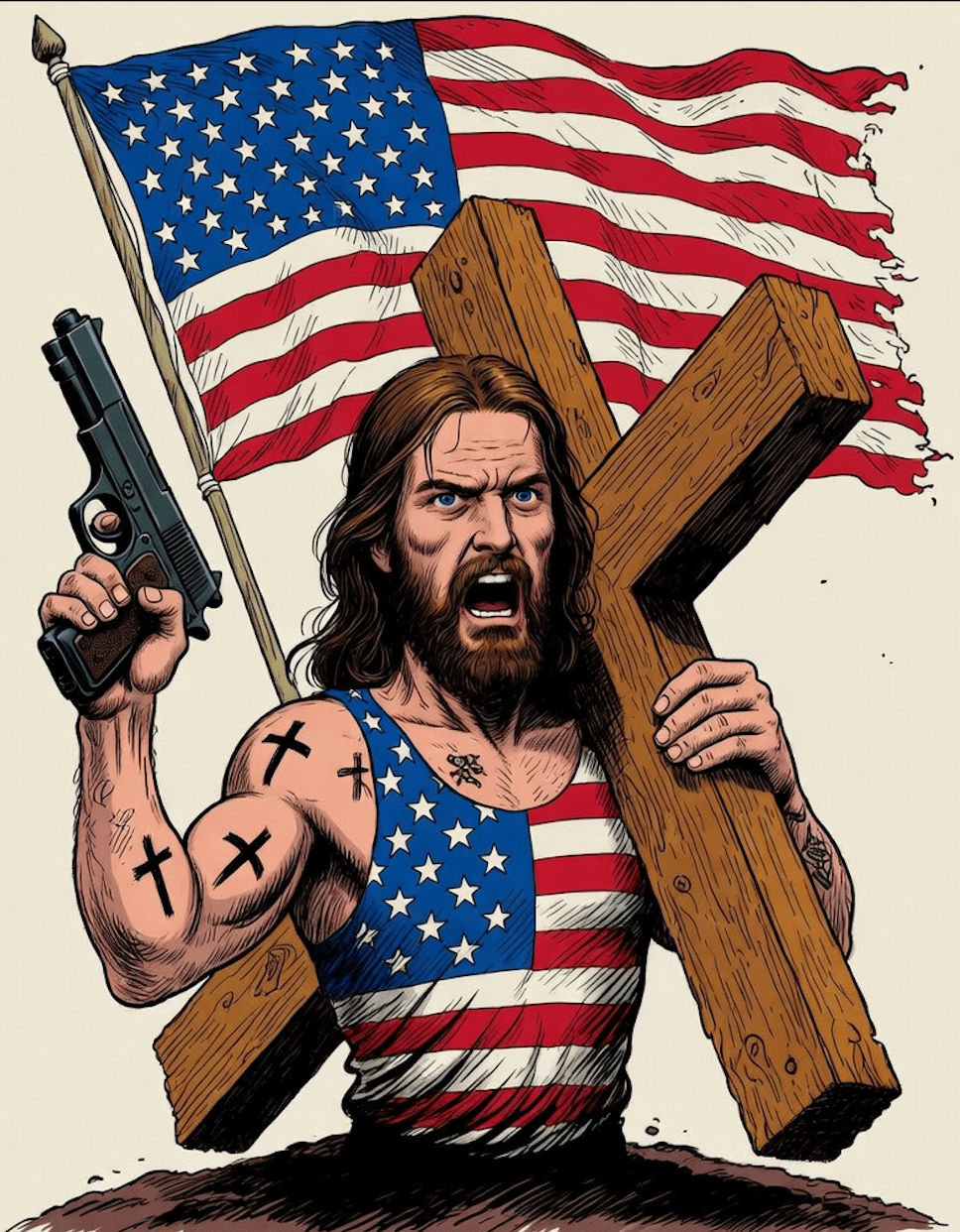
The tension between literal biblical interpretation and allegorical or psycho-spiritual readings has repeatedly shaped American Christian collective behavior in ways that Carl Jung described as projections of the shadow. Monotheistic traditions, in particular, can foster an identification with the “Good” that leads to externalizing the “Bad” onto an Other, whether a rival faith, a political foe, or a foreign civilization. This dynamic is not unique to any one group, but in the American evangelical context it has produced a pattern of actions framed as divinely mandated yet later viewed as profoundly misguided when measured against broader ethical, historical, or empirical outcomes.
As of April 7–8, 2026, this pattern is on vivid display. President Donald Trump’s Truth Social warnings that “a whole civilization will die tonight” if Iran failed to reopen the Strait of Hormuz—threatening to obliterate power plants, bridges, and infrastructure—prompted swift public breaks from longtime allies. Tucker Carlson delivered extended on-air rebukes, questioning the morality and strategic sanity of the rhetoric. Alex Jones labeled the language genocidal and warned of nuclear escalation, calling Trump a “husk” or puppet of foreign interests. Tim Dillon and Candace Owens similarly distanced themselves, framing the conflict as contrary to America First principles. Other high profile podcasters are walking back their previous support or issuing mea culpas. Yet polling and public statements indicate that white evangelical Protestants—Trump’s most consistent base since 2016, often exceeding 80 % support—remain largely steadfast. Franklin Graham and Paula White have continued to frame the administration in providential terms. This divide highlights a recurring theme: certain eschatological readings of the Old and New Testaments treat modern geopolitical events, especially those involving the state of Israel and Persia/Iran as literal prerequisites for the Messiah’s return or the Second Coming. These readings collapse symbolic, apocalyptic literature (Ezekiel 38–39, Revelation) into a literal historical script, projecting collective shadow onto perceived enemies and justifying escalation toward what some believers openly call “Armageddon.”
This is not a new phenomenon. American Christianity’s collective actions have, at key junctures, rested on literalist interpretations that later generations or outside observers deemed tragic errors in judgment. The following chronological examples illustrate the pattern without implying uniformity across all Christians—many believers have opposed each of these developments—but showing how organized, biblically justified movements produced measurable societal costs.
17th Century: Puritan Theocracy and the Salem Witch Trials (1692)
The Massachusetts Bay Colony was founded explicitly as a “city upon a hill,” a covenant community modeled on Old Testament Israel. Puritan leaders read Exodus, Deuteronomy, and the Pauline epistles as binding civil law. When economic stress, disease, and Native American conflicts intensified, literal readings of Exodus 22:18 (“Thou shalt not suffer a witch to live”) and Leviticus 20:27 supplied the theological warrant for the Salem trials. Over 200 people were accused; 20 were executed. Cotton Mather and other clergy defended the proceedings as defense against satanic conspiracy. Historians note the episode’s combination of spectral evidence, coerced confessions, and biblical literalism produced a moral panic that collapsed under its own evidentiary absurdity. The Massachusetts General Court later annulled the convictions and offered reparations, an early admission that zeal for scriptural purity had produced collective injustice. One might see here the projection of communal anxiety onto powerless individuals—mostly women and the marginalized—rather than confronting internal fractures.
19th Century: Biblical Defense of Slavery and the Southern Baptist Schism (1845)
The most enduring example remains the use of Scripture to sanctify chattel slavery. Southern clergy cited Genesis 9:25–27 (the “Curse of Ham”), Ephesians 6:5 (“Servants, be obedient to them that are your masters”), 1 Timothy 6:1, and the absence of explicit New Testament condemnation to argue that slavery was divinely sanctioned. When Northern Baptists moved to bar slaveholders from missionary posts, Southern delegates formed the Southern Baptist Convention in 1845, explicitly to protect the institution. The Confederate Constitution itself invoked “the favor and guidance of Almighty God” while preserving slavery. Post-war, 130 years later, the SBC issued an apology in 1995 for its racist past, acknowledging that “racism has been a stain on our history.” The alliance between Southern evangelicals and the Democratic Party (then the party of segregation) gave way, by the late 20th century, to a Republican realignment. Abortion and school prayer were the proximate triggers—but the deeper cultural continuity of white Southern Protestantism resisting federal racial reforms is well-documented by historians. Literalist hermeneutics had again aligned a major Christian bloc with a system later repudiated as morally indefensible.
Early 20th Century: Fundamentalism and the Scopes Trial (1925)
The rise of Protestant fundamentalism reacted to Darwinism, higher biblical criticism, and urbanization. The 1910–1915 “The Fundamentals” essays insisted on six-day creation, a historical Adam, and inerrancy. When Tennessee’s Butler Act banned teaching evolution, the 1925 Scopes “Monkey Trial” became national theater. William Jennings Bryan, three-time presidential candidate and devout Presbyterian, prosecuted on biblical literalist grounds, arguing Genesis must be taught as history. Clarence Darrow’s defense exposed the scientific illiteracy of strict literalism. Scopes was convicted (later overturned on technicality), but the trial damaged the public image of fundamentalism. Mainline Protestants largely moved toward theistic evolution; evangelicals doubled down. The episode illustrates how collective insistence on Scripture as science textbook can isolate a movement from empirical reality, a pattern repeated in later debates over climate, public health, and education.
Mid-20th Century: Segregation and Resistance to Civil Rights (1950s–1960s)
Some white Southern churches invoked the “curse of Ham,” the Tower of Babel (Genesis 11) as divine sanction for racial separation, and Acts 17:26 (“determined the bounds of their habitation”) to oppose integration. Bob Jones University maintained racial exclusion policies until 2000, citing biblical separation. While Black churches led the civil-rights movement with their own Exodus typology, many white evangelical institutions remained aloof or actively resistant until the 1970s. The 1960s saw the rise of “Christian academies” as flight from desegregated public schools—another instance where literalist readings of “order” and “authority” justified opposition to federally mandated equality. By the 1980s, most denominations had issued formal repudiations, but the political realignment of white evangelicals toward the GOP was already underway.
Late 20th Century: The Religious Right, Dispensationalism, and the Israel–End-Times Nexus (1970s–2000s)
The 1970s oil crises, Soviet invasion of Afghanistan, and Iranian Revolution revived premillennial dispensationalism—the belief that current events fulfill a literal prophetic timetable. Hal Lindsey’s The Late Great Planet Earth (1970) and the Left Behind series sold tens of millions, portraying Russia, the European Union, and a revived Roman Empire as players in Ezekiel and Revelation. Modern Israel’s 1948 founding and 1967 Six-Day War were read as literal fulfillments of 1948 and 1967 “fig tree” prophecies. This theology produced unwavering political support for Israeli policies, even when they conflicted with U.S. strategic interests or international law. The 1980s Moral Majority and Christian Coalition forged the Republican–evangelical alliance, prioritizing abortion, school prayer, and Israel over earlier Southern Democratic loyalties. Critics noted that this eschatology sometimes treated Middle Eastern conflict as desirable prelude to the Rapture, reducing diplomacy to delay of the inevitable.
21st Century: Trump Era and the Persistence of Eschatological Loyalty (2016–2026)
Donald Trump’s 2016 victory owed much to white evangelical voters (81 % according to exit polls). Despite personal scandals, he was cast as a “Cyrus” figure—an imperfect vessel used by God (Isaiah 45). Policies—moving the U.S. embassy to Jerusalem, recognizing the Golan Heights, Abraham Accords—were celebrated as accelerating prophetic timelines. The same literalist lens that once justified slavery or opposed evolution now frames Iran (“Persia” in Daniel and Ezekiel) as a prophesied antagonist. Trump’s April 2026 rhetoric threatening Iranian civilization is therefore received by many in this tradition not as reckless escalation but as potentially divine choreography. While Carlson, Jones, Owens, and Dillon—once reliable voices in conservative media—have condemned the move as un-Christian or un-American, evangelical leaders continue to voice support. Orthodox Jewish constituencies with their own literal messianic expectations often align on Israel policy, reinforcing the coalition.
Jung observed that the shadow grows more dangerous when wholly repressed or projected. When a group identifies itself exclusively with biblical “Good” and reads apocalyptic texts as literal roadmaps rather than symbolic maps of the soul’s confrontation with evil, the temptation to sacralize conflict increases. Persia, Babylon, Gog and Magog become not archetypes of hubris or chaos but literal targets. The result can be collective actions that prioritize prophetic timetable over prudence, human cost, or verifiable national interest.
None of this erases the genuine faith, charity, and moral witness of millions of American Christians who read Scripture differently—emphasizing the Sermon on the Mount, prophetic calls for justice, or allegorical depth. Mainline Protestants, Black churches, and progressive evangelicals have often led movements for abolition, civil rights, and peace precisely by invoking the same Bible through lenses of compassion and context. The danger lies not in Christianity itself but in any ideology—religious or secular—that treats complex texts as infallible political blueprints while disowning the shadow side of human motivation.
The 1980 Republican–SBC alliance did not invent biblical literalism; it harnessed an existing cultural reservoir. That reservoir has delivered real political power but also repeated episodes where collective certainty outran evidence or ethics. Whether the current Iran crisis becomes another chapter depends on whether the broader public, including the evangelical base itself, insists on separating apocalyptic symbolism from foreign policy. History suggests that when societies finally reckon with the human costs of such certainty—Salem reparations, SBC apologies, Scopes cultural retreat—they eventually step back. The question in 2026 is whether that reckoning arrives before further escalation or whether eschatological certainty continues to override caution. Democracy’s safeguard is not shunning any faith community but demanding that all citizens, believers included, subject their interpretations to public reason, empirical reality, and the shared recognition that no group holds a monopoly on the Good. Only then can the perennial human drama of shadow and light be confronted without projecting it onto the latest convenient “Other.”